
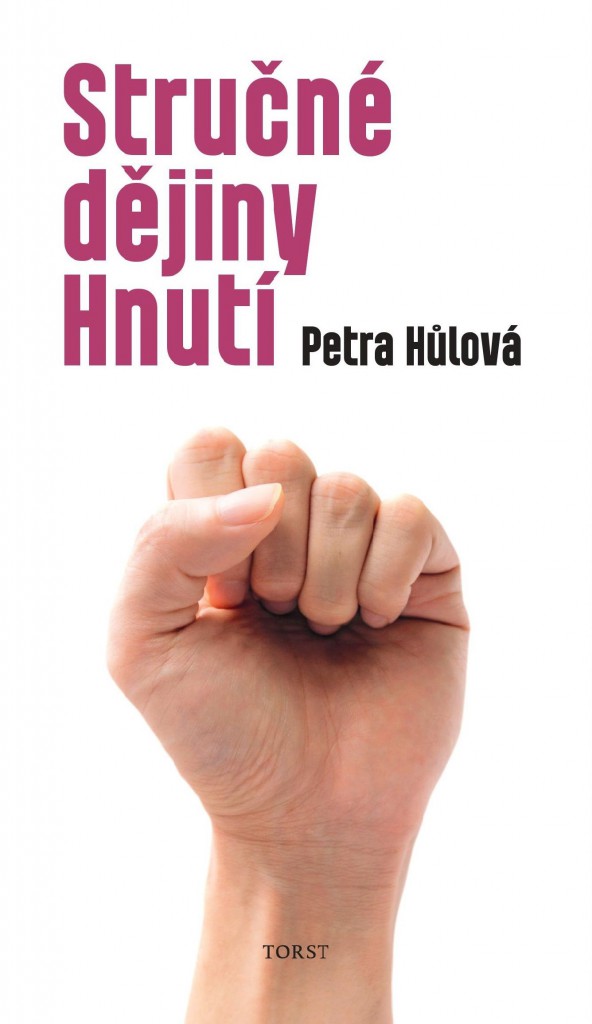
 Petra Hůlová
A BRIEF HISTORY
OF THE MOVEMENT
(Torst, 2018)
182 pages
The Movement has emerged victorious and created a new society run by women. Now, in order to consolidate its position, the Movement has established a network of institutes, where men and women alike undergo a reeducation program designed to eradicate the idea that men are by nature the dominant gender and women should be judged on their looks.
Věra, the institute educator who narrates the novel, intersperses her account of the Movement’s founding in her childhood years, and the backlash against it by the Guardians of Manhood, with the details of daily life for the men and women under her charge. In order to graduate from the program, each man must pass a test demonstrating his lack of erectile response to the sight of a young, physically fit woman and, by contrast, his ability to achieve orgasm while masturbating at the sight of an old, decrepit woman. Women undergo no similar test, but are judged on the degree to which they accept that there is no need for them to undergo cosmetic surgery or to wear clothes accentuating their bodies.
In addition to the obvious kinship with Margaret Atwood’s dystopian feminist classic The Handmaid’s Tale, resurgent in popularity thanks to current-day politics, attentive readers will also find in Hůlová’s compact novel echoes of John Berger’s Ways of Seeing (“An ethical environment for the development of little girls means that they see themselves as someone who looks and not a thing to be looked at”), as well as Virginie Despentes’s King Kong Theory, with its invocation of “the unfucked.”
Hůlová herself says the larger question that drove her to write this story was “whether anyone in history has ever given up their power voluntarily, whether it’s even possible for something like that to take place without actual or symbolic violence.”
 The author: Petra Hůlová (b. 1979) is the author of eight previous novels, two of which she has also adapted for the stage, as well as two original dramas. Her 2002 debut, Paměť mojí babičce, honored as the Magnesia Litera Discovery of the Year, was published in English in 2009 as All This Belongs to Me. Her fourth novel, published in Czech as Umělohmotný třípokoj in 2006, won the Jiří Orten Prize for best work of prose or poetry by a Czech author under the age of 30, and appeared in English in 2017 as Three Plastic Rooms. Her novels have been translated into French, German, Italian, Polish, Dutch, Swedish, and other languages. She is the most distinctive and outspoken Czech author of her generation.
SAMPLE
There are always vans parked out in front of the plant, although the lot reserved for them is nowhere near as full now as it was when I started out, which makes sense, since the vans are for picking up men trying to avoid treatment and the number of them is constantly on the decline. Voluntary admissions now exceed involuntary (what does victory look like if not this?), and many men actually look forward to coming to the Institute and having a chance to relax. We’re happy to let them do it, and those men come of their own accord. However, we’re careful not to advertise our spa services. We may not reveal everything, but we can’t be accused of lying, and our attorneys (all women) see to the rest. What greater relief could there be, for that matter, than ridding your mind of stupidity, so they’re actually right about it being relaxing.
Most of the questions we get on open door days have to do with our treatment procedures. I had the same questions running through my mind as I knocked on the reception desk window. In shifting gears from ideals to realization, things had broken down so many times before in human history that the Guardians of Manhood would have been crazy not to use that against us, over and over again citing the historic collapse of communism, and every other -ism that they claimed lured people in with nice ideas, only to end in terror, chaos, a lower standard of living, and, ultimately, the corruption of the ideal itself, which then, shorn of credibility, simply died away. The Movement viewed this scaremongering by our enemies as a sign of success, since the acceptance of our beliefs as a “nice idea” was a monumental improvement over the days when we were labeled extremist, following the detonation of explosives in the Ministry of the Interior’s basement—an act that catapulted the Movement from a misfit collection of “unfucked women” into the public eye and gave the old-world discourse a slap in the face that is now the subject of dissertations. Predictions of an inevitable debacle if our ideals were put into practice were the tactic of a rear guard in retreat. The Movement was too strong to ignore. You can label a third of the population misfits, but it’s bound to backfire politically, and when a country erupts in protest, civil war is just one step away. Nobody wanted that. And maintaining the status quo by way of discursive dodges ultimately came to seem more complicated to anyone with any common sense than the “leap into the unknown” that the Guardians of Manhood were warning about.
I was assigned an office, a housing unit, and a numerical code giving me access to spaces that were off-limits to clients as well as to workers from the other sections, except for section heads. I received a copy of the internal regulations and a set of work clothes. Then I was shown the cafeteria, the warehouses, a few of the client bedrooms, and a few of the clients themselves (men with normal responses and basket cases too, no preselection by PR). To wrap things up, my section boss devoted two whole hours of her precious time to me. Yes. The Movement values its workers, and also takes an individual approach with every client. We are all individuals and deserve to be treated as such.
“Stick to the discourse no matter what, as long as it doesn’t come off flat. Otherwise it’ll boomerang, take your head off like a slingshot. The trick is to use their strength against them,” my first section boss told me. Heavyset and in her fifties, she looked like the type of woman who ran a butcher shop, but in fact was the holder of a long-distance degree from Oxford. Appearance is meaningless in and of itself, as is hierarchy based on education and profession. My current section boss actually did used to work as a salesgirl in a butcher shop. One of the great draws for recruits to the Institute is the fact that there are no glass ceilings here, as I can confirm from my own experience. My tutor made herself available to me throughout my twelve weeks of training. I think of her often when I do the same for my new coworkers now, and more and more often nowadays, some of them are men.
I’m sitting in a circle with the clients in Building D, which falls within the scope of my duties and is under the direction of the Movement’s regional branch. The view from my workroom is taken up by buildings that used to be part of the meatpacking plant before they were occupied by Idea and Work. The work of the Movement is to transform the Idea into Work, and as I tell my clients the story of the little girl named Rita, some of them stare blankly out at the wall across the way, or through the windows giving onto the courtyard, which has been newly planted with decorative cherry trees (the bees’ buzzing was so realistic, even I couldn’t tell they were artificial, just like the cherries).
I usually start out like this: “Rita merely showed signs of heightened sensitivity to the injustices of the world around her.” Then, to help the residents absorb what that means, I tell them about that world. About how little Rita and her mother were walking down a boulevard in the European metropolis where our story begins, and in typical old-world style it was lined with hideous billboards. Rita pointed to one of them and asked her mother the question that sooner or later occurred to every little old-world girl, and the reason an ethical environment for the upbringing of girls didn’t exist in those days was precisely because the question wasn’t raised. It was a question that should never occur to any little girl, not because she shouldn’t think for herself, but because she should have no reason to—regardless of whether she formulates the question aloud, or keeps it to herself for fear of the answer and as a result it eats away at her, little by little, on the inside.
For inquiries or requests for a longer sample, email [email protected].


